Industry: Food & Beverage / E-commerce Strategy
Executive Summary
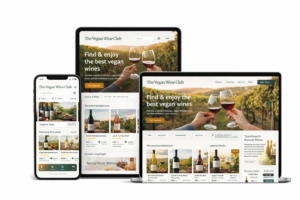
I led a consultancy project to assess the viability of a dedicated vegan alcohol proposition. Through a lean, customer-centred discovery phase, I identified that trust and reassurance mattered more than choice. I delivered a testable MVP concept and specific UI improvements that reduced commercial risk and provided a clear, evidence-based roadmap for investment.
My Role: Strategy Lead & UX Researcher (Full process from research and journey mapping to interaction design and testing).
Context and Challenge
Interest in vegan alcohol was growing, but the market was fragmented and labelling was inconsistent. The client faced a significant business risk: they didn’t know if demand was sufficient to justify a scalable product and a complex supply chain.
-
Customer Challenge: Identifying vegan status at the point of choice was difficult, requiring time-consuming external research and leading to low confidence.
-
Business Challenge: High risk of building a full-scale platform without validated demand in a poorly defined space.
My Approach: Evidence-Based Discovery
I led a discovery phase to define the problem and validate the opportunity. I focused on “human” needs rather than just market trends.
Activities included:
-
Survey (200+ respondents): To quantify consumer behaviours, attitudes, and pain points.
-
In-depth Interviews: Conducted with vegan consumers and industry experts to understand the “why” behind the data.
-
Friction Mapping: Identifying the specific moments where discovery, decision-making, and reassurance failed.
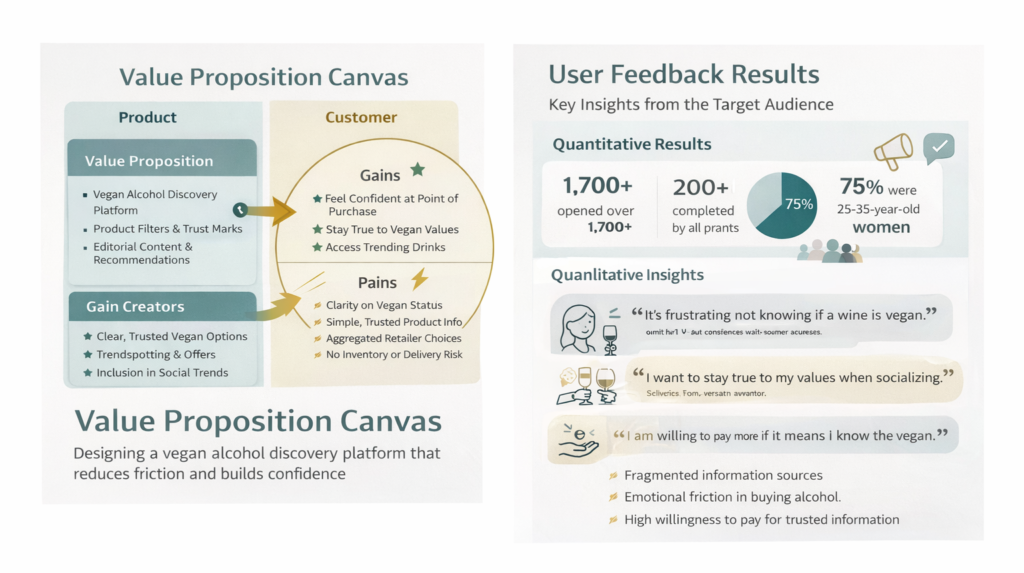
Key Insight: Consumers prioritised trust and simplicity over a wide range of options. Confidence mattered more than choice.
The Solution: A Lean MVP Concept
I shaped a product concept for The Vegan Wine Club focused on clarity and low-risk validation. The solution moved away from a “standard shop” to a discovery-led experience.
-
Credible Signalling: Made vegan status clear and easy to trust through curated certification.
-
Editorial Guidance: Simplified the path to purchase through curated selections and “Expert Picks” rather than a massive, unvetted catalogue.
-
Affiliate-Led Model: A model designed to validate demand and track purchase intent without the commercial risk of holding physical stock.
The Iteration: UI & UX Improvements
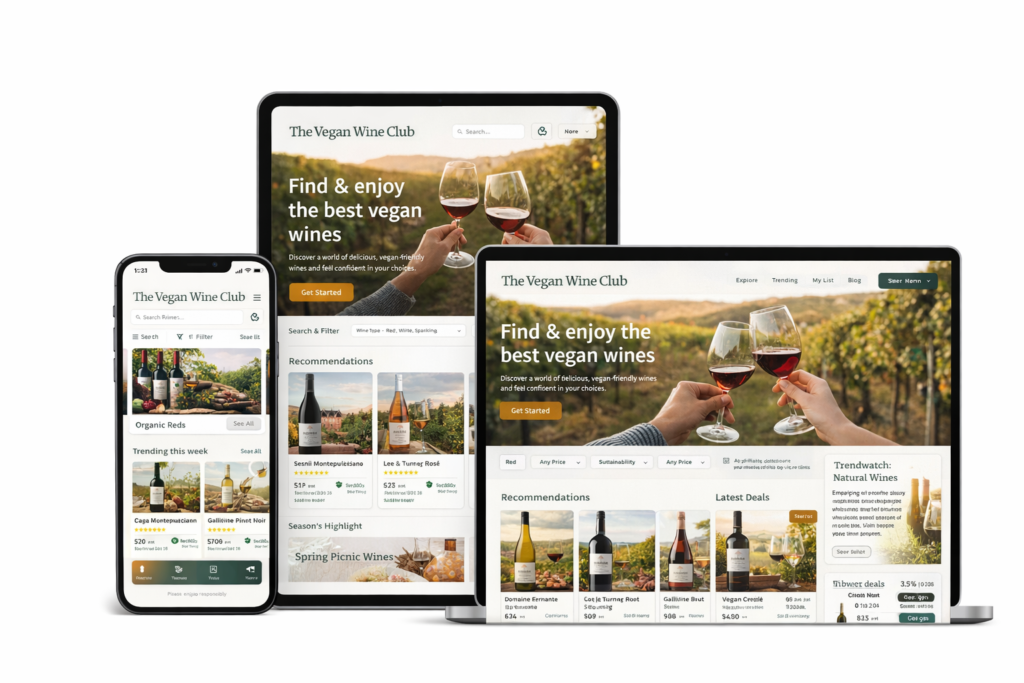
Based on direct feedback from testing the initial concept, I iterated on the UX to address specific user barriers.
-
Transparency Pivot: Users felt “subscription anxiety” during early tests. I redesigned the entry flow to move price transparency and vetted credentials before any sign-up wall.
-
Information Architecture: Improved the categorisation of “Speciality” wines (organic, biodynamic) to sit alongside vegan filters, allowing users to layer their ethical preferences without feeling overwhelmed.
-
The Result: These specific UI improvements turned “sceptical browsers” into “confident evaluators,” as validated in follow-up qualitative sessions.
The Outcome
The project allowed the client to make a data-backed decision on whether and how to proceed.
-
Client Outcomes: Clear evidence of demand, a defined value proposition, and reduced commercial risk through staged validation.
-
Customer Outcomes: Greater confidence through trusted signals and a significant reduction in the “detective work” required to find vegan products.
Key Learnings
-
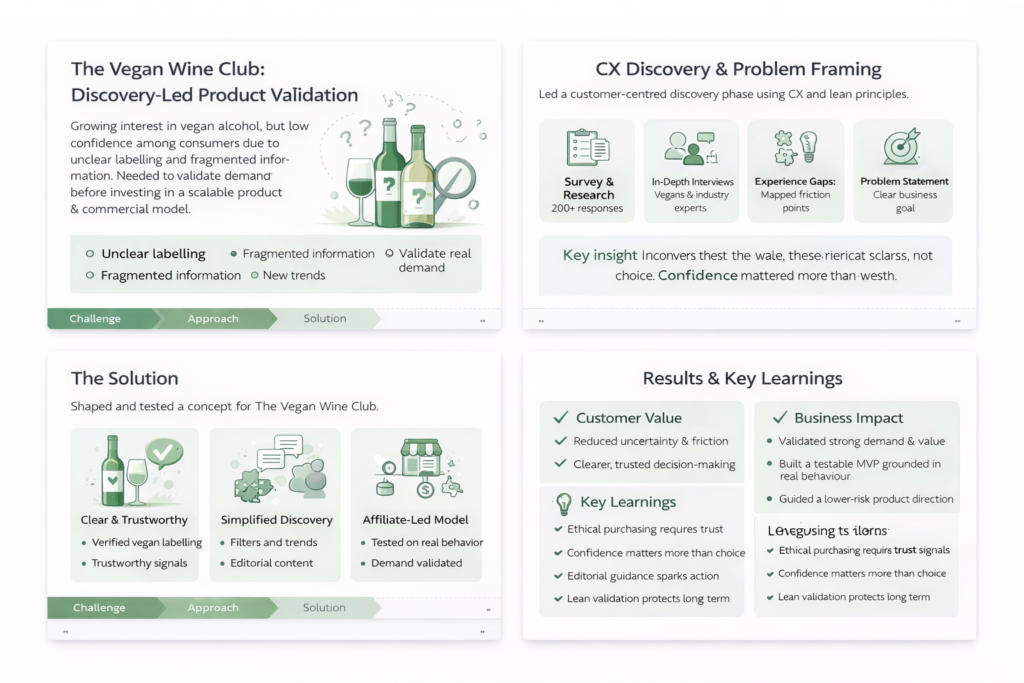
Trust is the Product: In ethical purchasing, the vetting process is often more valuable than the inventory.
-
Curation over Assortment: Editorial guidance can drive higher conversion than a large, unvetted catalogue.
-
Validation Protects Profit: Early customer-centred research protects both the customer experience and the business’s bottom line.