Industry: Digital Publishing / B2B (Entrepreneur Handbook)
Executive Summary
I led a content strategy and optimisation project for Entrepreneur Handbook, a leading UK digital publication for founders. By shifting the focus from search-volume acquisition to user-intent progression, I redesigned how information is structured across the platform. This approach turned a fragmented library of articles into a cohesive journey, significantly improving reader engagement and conversion metrics.
My Role: Content Strategist / UX Researcher (Research, Framework Design, Editorial Strategy).
Context and Challenge
Entrepreneur Handbook supports founders with practical guidance on starting and scaling businesses. While the platform had strong organic traffic, most readers were consuming a single article and then leaving.
-
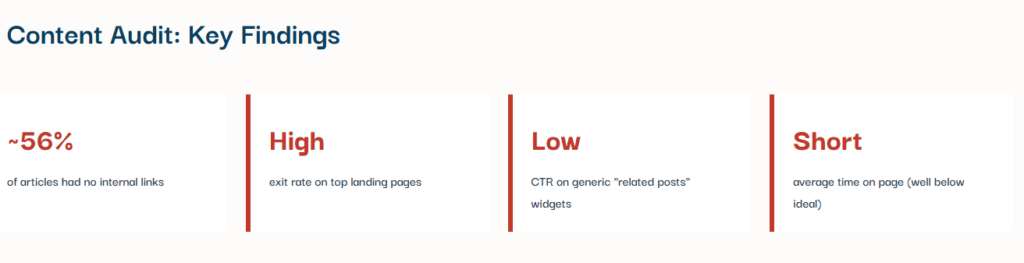
The Experience Gap: Articles were optimised for search engines rather than reader progression. There was a limited sense of sequencing between topics, meaning users lacked a clear understanding of what to do next after reading a guide.
-
The Business Challenge: The platform relied heavily on acquisition but struggled with return engagement. As the content volume increased, strategic cohesion decreased, making it harder for founders to find a clear path through complex business topics.
My Approach: Strategy Rooted in Intent
I approached the audit by looking at content as a service rather than just information. I focused on the “Jobs to be Done” for a founder at different stages of their journey.
The specific steps I took included:
-
Discovery and Analysis: I spent three weeks analysing heatmaps and scroll tracking on high-traffic pages. I also interviewed early-stage founders to understand how they actually applied the advice they read online.
-
Framework Development: I created three core frameworks to guide the restructure: a user intent taxonomy, a comprehensive journey map, and a manual internal linking strategy.
-
Content Categorisation: I defined four new content types to ensure every piece of work had a specific purpose: Foundation Guides, Decision Frameworks, Action Templates, and Confidence Builders.
-
Execution and Refinement: Over eight weeks, I oversaw the rewriting of top-performing guides. Each article was redesigned to include a front-loaded decision framework and an explicit “what happens next” section.
Templates
The Solution: From Information to Action
The solution was to move away from automated “related posts” and toward manually curated, strategic journeys.
-
Front-Loaded Decisions: Using the “How to Start a Limited Company” guide as an example, we moved away from an A-Z process. Instead, we added a “Should you even start one?” framework at the beginning to help users make the right decision before following the steps.
-
Contextual Internal Linking: We replaced generic sidebar links with three to five manually selected next steps that provided the reader with a logical progression path.
-
Trust Signals: I introduced specific caveats and limitations within the text to build credibility and manage user expectations.
The Iteration: Testing Engagement Signals
During the rollout, I monitored how users interacted with the new layouts and identified several areas where we needed to scale back.
-
The Feedback: We found that journey-based tags were largely ignored, and generic “Next Steps” boxes were often skipped by readers who perceived them as adverts.
-
The UX Improvement: I pivoted the design to embed the next steps directly into the narrative of the article. I also reduced the number of internal links from eight down to three high-value options to prevent choice paralysis.
-
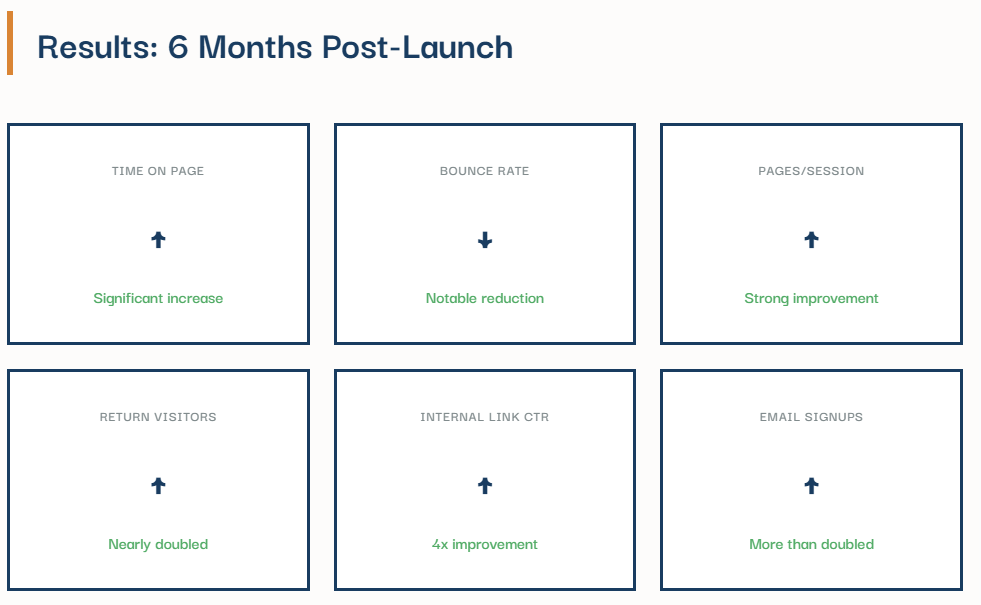
The Result: By making the progression feel like a natural part of the editorial voice, we saw a marked increase in scroll depth and click-through rates.
The Outcome
The project proved that content effectiveness depends on progression rather than volume.
-
Business Impact: We saw a significant growth in organic traffic driven by improved engagement signals. Email signup conversions increased, and the platform achieved better featured snippet performance on Google.
-
Qualitative Success: User feedback highlighted the clarity of the next steps, and help desk mentions began to reference specific content journeys rather than isolated articles.
-
Production Efficiency: The editorial team moved to a “quality over volume” model, which made content production more efficient and strategically aligned.
Key Learnings
-
Progression over Volume: A site is more valuable when it helps a user move forward, not just when it provides more data.
-
Trust through Transparency: Including limitations and caveats in advice-based content builds a stronger bond with the reader.
-
Curation Beats Automation: Manual, human-led linking strategies consistently outperform automated algorithms for complex, intent-driven topics.